When an industrial roof starts leaking or showing signs of deterioration, the industrial roof repair or replacement decision can have significant cost implications. It can also be easy to overthink. A leaking or ageing roof does not always mean a full replacement is necessary, and in many cases a localised repair may be enough to resolve the problem and extend the life of the existing roof.
A localised leak, damaged sheet or early-stage corrosion certainly doesn’t mean an entire roof needs replacing. On the other hand, repeatedly repairing an ageing roof with widespread deterioration can become an expensive way of postponing work that will eventually be required.
For project managers, site managers and building owners, the decision usually comes down to the condition of the existing roof, the extent of the problems, expected lifespan and cost of ongoing maintenance.
Here’s how to decide which approach is right for your building.
When Is an Industrial Roof Worth Repairing?
Repair is generally the most sensible option when defects are localised and the majority of the existing roof remains in good condition.
Typical industrial roof repairs include:
- Repairing leaks
- Replacing damaged roof sheets
- Treating cut edge corrosion
- Replacing failed fixings
- Repairing flashings and sheet laps
- Repairing or lining industrial gutters
- Replacing damaged rooflights
- Applying protective roof coatings
For example, if we find early signs of cut edge corrosion but the rest of the roof is still in good condition, there’s usually no reason to replace the whole roof. The affected areas can often be treated before the corrosion gets worse, helping to get more life out of the existing roof. It’s the same with leaks.
Water getting into the building doesn’t always mean the roof has failed; sometimes it can be something as simple as a leaking gutter joint, damaged flashing or a problem around a rooflight. The important thing is finding out where the problem is coming from before deciding what work actually needs doing.
Industrial Roof Repair or Replacement and When Should You Replace?
The decision starts to change when the problems are no longer isolated. One leak here and there can usually be dealt with as part of normal roof maintenance, but if water keeps getting in at different points across an ageing roof, it’s a sign that there may be a wider problem. At that stage, it makes sense to look at the condition of the roof as a whole rather than continuing to repair each new leak as it appears.
Other signs that replacement or major refurbishment may be worth considering include:
- Widespread corrosion
- Large numbers of deteriorated roof sheets
- Repeated previous repairs
- Extensive coating failure
- Persistent water ingress
- Deteriorated rooflights
- Poor thermal performance
- Significant problems affecting gutters and drainage
- An ageing roof approaching the end of its useful life
At this stage, it’s worth comparing the cost of continued maintenance against the cost and expected lifespan of a longer-term solution. A repair might cost less today, but that doesn’t necessarily make it the lowest-cost option over the next five or ten years.
Repair, Refurbish, Overclad or Replace?
When there’s a problem with an industrial roof, the choice isn’t always between carrying out a small repair or replacing the whole thing. There are a few options in between, and what we recommend will depend on the condition of the existing roof, where the problems are and what you want to get out of the building over the next few years.
1. Targeted Roof Repairs
If most of the roof is still in good condition and the problem is limited to one or two areas, a targeted repair will often be the most sensible option. This could mean replacing damaged sheets or fixings, repairing flashings, treating corrosion, sorting a leaking gutter or dealing with a problem around a rooflight. If the rest of the roof has plenty of life left in it, there’s little point recommending more work than is actually needed.
2. Roof Refurbishment
Sometimes a roof needs more than a few repairs but still doesn’t need to be completely replaced. In this situation, refurbishment may be worth considering. The work can involve repairing the areas that have started to fail and then treating or coating the roof to help protect it going forward. This will only be worthwhile if the existing roof is in suitable condition to begin with. There’s no benefit in putting a new coating over a roof that has more serious problems underneath.
3. Industrial Roof Overcladding
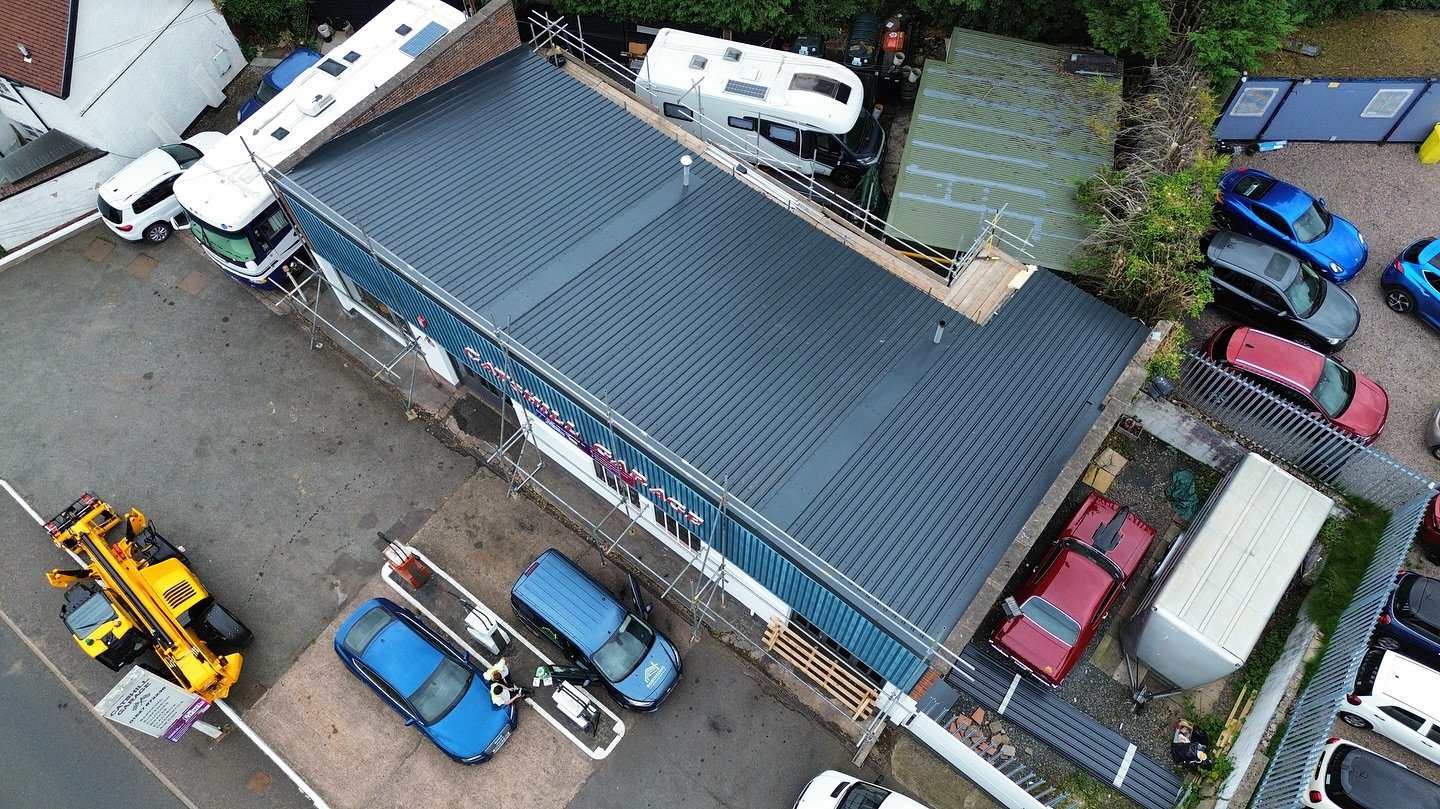
Industrial roof overcladding is another option and involves fitting a new roof covering over the existing one. On the right building, this can be a good alternative to stripping everything off and starting again. It can help improve the weather protection and insulation of the building while keeping disruption on site to a minimum.
This is particularly useful on working factories, warehouses and agricultural buildings where the customer needs to keep the site running while the roofing work is being carried out. Overcladding isn’t suitable for every roof though, so we would first need to check the condition of the existing roof and the structure supporting it.
4. Complete Roof Replacement
There comes a point where continuing to repair an old roof stops making financial sense. If deterioration is widespread, leaks keep returning or large areas of the roof are reaching the end of their life, a complete replacement may be the better option. It costs more upfront, but you’re starting again with a new roofing system rather than continuing to spend money repairing an old one.
If you’re trying to get an idea of what a larger project may cost, have a look at our Industrial Roof Replacement Cost UK guide, where we explain the main things that can affect the price of the work.
What About Asbestos Cement Roofs?
We still come across plenty of asbestos cement roofs on older factories, workshops, warehouses and agricultural buildings across the UK. Finding asbestos in a roof doesn’t automatically mean that the whole roof has to come off. The first thing is to look at its condition, how the building is being used and what work actually needs doing.
Depending on the roof, the answer may be to manage it, carry out suitable repairs, overclad it or remove it and install a new roof. Asbestos does need to be taken seriously, though, and any work involving asbestos-containing materials needs to be properly assessed before work starts. The Health and Safety Executive has further guidance on asbestos for building owners and those responsible for managing premises.
We’ve also covered this subject in more detail in our guide to Asbestos Cement Roofs and Your Legal Duties.
Can an Industrial Roof Be Replaced Without Shutting Down?
This is something we’re often asked by customers running factories and other busy sites. In many cases, the answer is yes. Repairs, overcladding and even larger roof replacement projects can often be planned so that the business can continue operating while we carry out the work.
It needs to be planned properly from the start. We need to understand what is happening inside and around the building, where people are working, how vehicles move around the site and whether there is machinery or stock below the areas we’ll be working on. From there, the job can often be carried out in stages to keep disruption down as much as possible.
Every site is different, so this is something we would discuss before work starts. We’ve explained the subject in more detail in our guide to factory roof replacement without shutting down.
Don’t Just Look at the Upfront Cost
Price is obviously going to be part of the decision, but the cheapest quotation today isn’t always going to save you the most money in the long run. If a fairly small repair will give a sound roof another few years of useful life, replacing it early probably doesn’t make sense. If you’re paying for repairs every year and new leaks keep appearing, the numbers can start to point the other way.
When looking at industrial roof repair or replacement, we would consider the cost of the work alongside how long the solution should last, what maintenance is likely to be needed afterwards, the risk of further leaks, disruption to the site and how long you intend to keep using the building. A more expensive option can sometimes work out better value when you look at the roof over five, ten or more years rather than just the immediate cost.
How We Decide Whether a Roof Should Be Repaired or Replaced
At Robinsons Roofing & Cladding, we don’t turn up to an ageing roof assuming it needs to be replaced. We start by finding out what is actually wrong with it. We’ll look at the roof sheets, fixings, flashings, rooflights, gutters and drainage, as well as checking for corrosion, previous repairs and signs of water getting into the building.
We also need to know how the building is being used. Working on a busy factory is different from working on a warehouse, workshop, barn or agricultural building, and that can affect how we approach the job. If repairing the problem is a sensible option, we’ll say so. If the roof would be better refurbished or overclad, we can explain why, and if it has reached the stage where further repairs are simply throwing good money after bad, we’ll discuss replacement.
Industrial and Agricultural Roof Repairs Across the UK
Robinsons Roofing & Cladding carries out industrial and agricultural roofing work throughout the UK. Being based in the West Midlands also puts us in a good position for projects across Wolverhampton, Birmingham, Staffordshire, Shropshire, Worcestershire and the surrounding areas, whether that’s a large industrial job or roofing work on a farm or agricultural building.
We carry out industrial roof repairs, cut edge corrosion treatment, gutter repairs and lining, roof coatings, rooflight replacement, overcladding and complete roof replacements. We’re also members of the Confederation of Roofing Contractors and provide warranties on our roofing installations.
Not Sure Whether to Repair or Replace Your Roof?
If you’re weighing up industrial roof repair or replacement, the first step is finding out what condition the existing roof is actually in. Once we know where the problems are and how much of the roof is affected, we can give you a clearer idea of whether it’s worth repairing, refurbishing or overcladding the existing roof, or whether replacement would make more sense.
If you have a leaking or ageing industrial or agricultural roof and aren’t sure what it needs, speak to our industrial roofing team. We can take a look at the roof, talk through the options and recommend what we believe is the most sensible way forward.
